We are Presenting Online at the Library 2.013 Worldwide Virtual Conference

We are Presenting Online at the Library 2.013 Worldwide Virtual Conference

Join Tiffany and Susanne for a free online, one-hour session today. They will talk about the book and the survey, and will focus their discussion on transitioning from one role to another, staying current and motivated, and finding alternative roles. Bring your questions and ask them live!

Library 2.013 Conference
Career Management 101: Setting a Path for Success

Date/Time: Saturday, October 19, 5:00 – 6:00pm Eastern Standard Time

Description: As authors of the popular “Career Q&A with the Library Career People” web site, we’ve been answering career-related questions for ten years. We’ve recently published a book based on our Career Q&A site, and we’ve conducted a national survey that addresses different aspects and stages of a librarian’s career. For our session, we will share data and responses from the survey, as well as provide advice and tips on how to manage a successful career in libraries no matter what stage of your career, and discuss how to transition from one role to another, how to keep yourself motivated and current in a rough job market, and how to find alternative and flexible roles in our evolving profession. And we will save time at the end to answer your career-related questions.

Full Schedule: http://www.library20.com/page/sessions-and-schedule

Q: How do I make the switch from a non-profit to an academic library?

Q: How do I make the switch from a non-profit to an academic library?

Q: I was an art director for 12 years and then went to library school. I have been working at a large non-profit for the past 2.5 years doing in depth reference requests, writing white papers, creating information graphics, creating web pages, very light cataloging, strategic planning for the information center. Although I am in a non-profit, the setting is VERY corporate and I am not really finding a comfortable fit. I would like to switch to academic (I also have an MFA) or find another non-profit that is less corporate. Ideally a career that marries my excellent research skills with design and writing. I am lost? Any advice? In library school I kept hearing how employers wanted librarians who could design, but I am not seeing that at all.

SM: This is a great question. You seem like you would be the perfect fit for an academic position. You have experience doing research, writing, strategic planning, creating and designing web pages and other materials, and you have an additional advanced degree (and you were an art director!). This all seems quite impressive and completely suited to a career as an academic librarian.

However, as you’re starting to figure out, the fact is – it can be bloody difficult to break into the academic library world, especially when you don’t have academic library experience. I hear this from so many people — new librarians, and those who have worked in other types of libraries — who just can’t get a foot in the (academic) door.

Now, it could be that part of the reason you are not getting interviews or jobs is that there just aren’t that many jobs available in whatever geographic area you are searching in, or you are being overly selective in your search. Whatever the reason, don’t give up your job search if academia is where you want to be. Here are some tips and ideas that may help:

Overhaul your résumé – create a CV that emphasizes and highlights your “academic-like” work: writing, reference, research, training, web design, cataloging, etc.

Start small – if you have never worked in an academic library, then that is one strike against you (unfortunate, but true). Look for part-time/adjunct reference work in an academic library, or an internship of some kind. These positions can provide you with experience and contacts who can serve as references when looking for full time work. And, these positions could potentially turn into full time jobs. In other words, identify the experience you are lacking (look at job descriptions) and go out there and get it.

Specialize, and sell yourself as special – what type of library position do you want? Why types of jobs are you applying for? Do you want more technical services, more public services, or a combination? Do you enjoy instruction or outreach? Would you like to be a subject specialist? It will be easier to get a job if you have a clear idea of the type of role you want to be in. Academic libraries and librarian roles can be quite different from special libraries (or corporate libraries)… different missions, different clientele, different expectations. And in some academic libraries you may be required to serve on committees and publish and prove your worth (so to speak) as a member of the faculty. Research, writing and design skills are all wonderful — but these are somewhat common amongst librarians. You need to combine them with something special, something that a hiring committee will remember.

Diversify – have you considered all types of academic libraries? How about community colleges, for-profit colleges, specialized schools (like design schools or trade schools)?

Write thoughtful cover letters – again, highlight your “academic-like” experience, and talk about why you want to move to an academic environment and how your experience and skills make you a great candidate for the job at hand (just remember to tailor each cover letter to the requirements of the specific job). Check out ones that have worked.

Utilize what you know – I always like to talk to and interview people who have worked in other areas, in different types of libraries, and had different careers. They tend to bring in new ideas and new ways to get things done. In your application materials, and during interviews, make sure to relate your past and current positions and the varied skills you obtained along the way, to academic librarianship and the job at hand. We call this: highlighting transferable skills. And these can make you special.

Create an online portfolio – which will be useful for displaying your graphic design work. This way, potential employers can view it and decide for themselves if your skills can be useful. You are right that web and design skills can be extremely beneficial for a librarian to have (and will come in handy, I guarantee it!), but unless the job specifically asks for those skills, then I wouldn’t emphasize them too much. From my experience, design skills are more of a bonus than a deal-breaker.

Become involved – join academic library organizations and associations in your area. Get to know people who may be able to help you find that job. Ask questions, volunteer for things, find a mentor or someone to talk to, get advice about your application materials, and ask your contacts to keep an eye out for job openings.

The job search process – and moving from one type of library to another – can be daunting and lengthy; but with a little ingenuity and a lot of patience, you should be able to get your foot in the door, and secure the type of job you desire. Good luck!
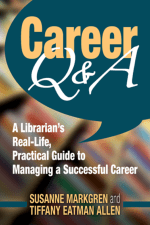
The Book is Here!

The Book is Here!

We are thrilled to announce the publication of our book, in print and ebook format. If you like our site, and like our advice, then you will like our book. We cover a variety of career topics and most chapters include sidebars from working librarians at different stages of their careers. We hope you like it, because it wouldn’t have been written without this site, and our readers.

Career-QA

Career Q&A presents the following 14 chapters:

  1. The Beginning: Getting Started or Getting Going
  2. Making a Good First Impression: The Art of the Cover Letter
  3. Documenting Your Employment History: The Art of the Resume
  4. Online Identities: Managing Your Online Presence and Building Your Brand
  5. Interviewing: Getting Ready for the Show
  6. Networking: Getting Involved in the Profession
  7. From Here to There: Time for a Change
  8. Putting Yourself Out There: Presenting and Writing
  9. Job Flexibility: Possibility or Myth?
  10. Alternative Jobs: The Nontraditional Career Path
  11. Moving Up the Ladder: Stepping Into Management
  12. Keeping Up: Following Technology and Trends
  13. Collaboration: Forming Productive Partnerships
  14. Retirement: Wrapping Up Your Career and Planning for the Next Stage

Go here or here or here for more information, to read a sample chapter, and to purchase the book.

Q: Should I contact a potential employer with questions before applying for a job?

Q: Should I contact a potential employer with questions before applying for a job?

Q: I’m just about to finish my MLIS and I am hopefully about to begin my career in librarianship. One thing I am unsure about is whether or not you should contact the person listed for informal inquiries prior to applying. Some people say it is useful as it will put you on the radar of those hiring while others discourage it. One particular position I am looking at at the moment is listed as a Trainee role and I thought it might be useful to ask about the training they will be offering (for example). Should you contact them or just apply?

SM: Congratulations on completing your degree and best of luck to you as you begin your library career!

Trainee positions (and fellowships) are designed to provide recent graduates with experience and actual hands-on training prior to getting that first professional position. The trainee role can be beneficial for someone with little or no prior library experience and it can also be an excellent entrée into librarianship for any new librarian.

These types of positions can mean different things in different libraries, so you will want to make sure that you understand all the requirements, expectations,  and terms. Trainee positions may be for library school students or for recent graduates. They can be temporary (one-year, academic year, etc.), or they can encompass the first year of a permanent position… a trial period where one learns the ropes before taking on greater responsibilities.

Overall, I think these programs are very much needed — both for the growth of our individual careers and for the health of the profession. We need to continue to develop programs for mentoring and nurturing our newest members, in order to create the next generation of dynamic and confident leaders; and we need to take the time to fully train and integrate new hires into their roles and help them to meet and exceed the demands and expectations that are put on them.

Here are my thoughts on asking questions of potential employers:

  • If there is an actual person listed, and they are defined as the person to contact for “informal inquiries” then go ahead and contact that person.
  • Since this is a trainee position, which is different from a typical position, you may want to clarify exactly what you will be doing on the job, especially if is isn’t clear in the job description.
  • Do not think that by contacting a potential employer with questions that you are putting yourself in a better position to get the job. Getting on someone’s radar is not always a good thing.
  • In the interview stage you will have a chance to get all your questions answered. This is the place to ask lots of questions, not necessarily before you apply for a position.
  • Think of ‘getting an interview‘ as an accomplishment, and ‘interviewing‘ as training. The more you interview, the better you get at it. And interviewing is the only way to know if you really want a position. Something that looks great on paper may be not-so-great in person, and vice versa.

To sum up: if you have pressing questions that you would like answered before you apply and the job listing has a contact for asking questions, then you should feel free to ask. If there is no name listed, you can attempt to contact the human resources department to get your questions answered (do not contact the library director!). As long as you maintain a professional demeanor and don’t attempt to promote yourself in your correspondence (or get noticed or rewarded in any way), then all should be well.

Q: What are the pros and cons of pursuing a professional certification in an area you may not have much experience in to expand future employment opportunities?

Q: What are the pros and cons of pursuing a professional certification in an area you may not have much experience in to expand future employment opportunities?

Q: I have been out of library school and working in a non-traditional role for 6 years as of today. Though I am employed (sometimes underemployed, depending on project funding), I am considering whether or not it’s time to try making a career move now that I have some experience under my belt. I have been job hunting as as I will not be able to move upward (or negotiate any sort of raise or additional responsibility) in my current position. After 6 steady months of job hunting (and a highly encouraging interview, though I was not offered the position) I’m beginning to realize the library job market in my area is just plain tough, and it seems likely to remain that way for the next few years. For family-related reasons I’m not able to easily relocate to seek employment and I’ve been wondering, what’s the best way to plan for career advancement if you aren’t able to make an immediate move to a new position? I am considering pursuing either a professional certification in an area such as records or knowledge management or possibly enrolling in some programming classes at a local community college. What are the pros and cons of pursuing a professional certification in an area you may not have much experience in to expand future possible employment opportunities? Would associate-level technology training pair well with an MLIS degree as a segue into systems librarianship?

SM: One might argue that you should always be planning for career advancement, whether or not you are currently job hunting. A career (not a job, necessarily) is something to hone, to mold, to build, to grow. It is continuously in flux and we should be improving our skill sets and pursuing new education all the time.

It can be difficult when you are feeling stuck (for lack of a better word) and are unable to move out to another job or move up to a better one. This is a common dilemma – you are not alone – and there are countless reasons why people stay in places and roles that are not ideal. But as long as you have goals (both short and long term) and continue to pursue new opportunities and explore new professional outlets, then there is hope.

A professional (or advanced) certification can certainly enhance your resume and provide you with new and potentially necessary skills for a job in a particular area. Some libraries/institutions may require a certification or specialization (or prefer one) depending on the area, for example: archives, library media specialist, digital libraries, preservation, law, or museum libraries. Be aware, however, that getting a job in that area without having work experience in that area, may be difficult even with the certification. So you should also look into volunteer work or an internship or hands-on projects at your current workplace, which can all count as experience.

I can’t say that pursuing a professional certification will definitely be worth it for you, but if you’re willing to spend some time and money as you bide your time in your current position, the best things you can do are –

  • advance your education
  • acquire experience
  • build up your resume
  • make new connections

If you are going to specialize, you should feel a strong pull towards working in that particular area, so you may want to try to get some experience first or at the very least talk to specialists and find out what they do, what they needed to do to get a job, and what they love about their job. It is good to specialize, but also good to get experience in different areas because you never know what type of position might come up, and what type of experience you might need to get the job you want.  I like to think that each job or role you have is a segue into your next one, and each skill you acquire and each connection you make can be a segue into new opportunities.

Technology training can be beneficial for any type of library role and will almost always come in handy at some point (think — photo editing, web design, graphic design, digitization, database design, statistics, metadata, and more). I have taken several technology and software specific classes in the course of my career and I have learned from each one. Getting an associate’s degree in a technology field can pair well with a tech-heavy librarian role, such as systems librarianship, and may be required for a small number of those jobs. However, if you have the experience and the skills needed, the advanced certificate or degree usually isn’t a requirement. Finally, seek out classes and events and associations that interest you and keep your job options open (especially since you are limited geographically) by considering non-traditional or alternative librarian roles which can be challenging and rewarding and can help to propel your career upward.

A few certification/specialization program within library schools:

Advanced Certificate Program – LIU Post

Advanced Certificate Programs – Pratt

Advanced Study Certificate – UW-Milwaukee

Certificate of Advanced Studies, iSchool, Syracuse University

Specializations – School of Information, University of Texas at Austin

A Decade Later… and a Brand New Look

A Decade Later… and a Brand New Look

Dear Readers,

We are pleased to announce the launch of our new website, Library Career People.

The Career Q&As have been moved to this new site, so all 10 years worth of Q&As are still searchable and browseable.

And, most importantly, we are still answering your career-related questions, so please keep them coming. The new site offers more sharing features and will make it easier to submit a question (via a form on the site).

Another reason for the new site is to highlight and promote our upcoming book: Career Q&A: A Librarian’s Real-Life Practical Guide to Managing a Successful Career (to be published this Fall, by Information Today). The book is, in essence, a byproduct of all the great questions we’ve answered over the years, as well as responses from a survey we conducted, interviews and essays from librarians working in all different types of roles in different types of libraries, and our own experiences as working librarians.

The new site will also highlight upcoming events and workshops that we are involved in, as well as our publications and presentations that are relevant to librarians and their careers, and data and responses from the librarian career survey.

The former location, http://www.lisjobs.com/careerqa_blog/, will redirect to the new site for a while, but please update your bookmarks and subscribe to the new site to stay current on new content.

And, one more thing, we have a Twitter account, where we will post links to Q&As, and other news and information we deem useful to our readers. Please follow us at: @LibCareerPeople

Thanks for all your support!

The Library Career People

Q: How does a part-time librarian find affordable health care insurance?

Q: How does a part-time librarian find affordable health care insurance?

Q: Dear Library Career People, 

I have so many questions I could ask but one dilemma is weighing on my mind (and affecting the contents of my wallet!): lacking health insurance as a part-time librarian. 

I absolutely adore my job as a YA librarian, but I am employed part-time. Though the job market for librarians has gotten a teensy bit better, competition is still fierce. I have yet to land another part-time position (which still wouldn’t give me insurance) or a coveted – and increasingly rare – full-time position. There is no option to “buy-in” to my employer’s insurance and civil service law limits my hours so I won’t qualify for that 30+ hour part-timer Obama law.

I make slightly too much income for state-sponsored programs like Medicaid but far too little to pay for private insurance out of pocket ($1,300/month?!). I know supposedly the new Affordable Care Act will change things next year, but do you know of any options that could help me? Do any professional librarian organizations offer group insurance? 

I know I can’t be the only part-time public librarian struggling with this. Please help if you can and thank you in advance. 

SM: You are definitely not the only part-time librarian to struggle with this issue, and you certainly won’t be the last. Lack of health insurance is one of the biggest drawbacks of working in a part-time position. It’s great that you love your job, but healthcare (or being able to afford health care benefits) is extremely important. Yes, things may change for the better in 2014 under the Affordable Care Act, but you can’t be certain. So, your options come down to: find a different job that offers health insurance (not that practical), find another part-time job that offers health insurance (not so easy), marry someone who has health insurance (ummm?), have someone claim you as a dependent (rather unlikely), or pay lots of money for private insurance (sigh).

It seems like you’ve already looked into any possibility of getting on your employer’s insurance, or getting a lower rate because of your employer. If you haven’t yet, I recommend that  you talk with your supervisor and your human resources department to see if there is anything that can be done or any prospect of changing your existing position into one with benefits (you never know until you ask). Finally, you may want to talk to family members, colleagues, and other part-timers, to see if they have any suggestions and to find out what kind of health insurance they have. And, I’m not sure how old you are, but if you are younger than 26, you may have the option to be added to your parents’ plan.

The good news is that some state level library associations do offer discounts to their members on health insurance plans (for example, NYLA) and some universities offer medical plan discounts to alumni (for example, California State University, Long Beach). So check our your state and local library organizations, and any alumni association that you may be a member of, to find out.

Below are some resources that may provide you with more assistance or information on the current state of part-time positions. The good thing is that you are working in a job that you love and you are getting valuable experience which will help you get that next job… which will hopefully come with benefits. Good luck to you!

On-call, Pool, and Substitute Librarians Facebook Group

Association of Part Time Librarians

The Art of Part-Time
by Sandra Collins and Allison Brungard

Part-Time Work Becomes Full-Time Wait for Better Job
by Catherine Rampell

A Permanent Alternative: Temporary, Part-Time Library Work
by Jennifer Johnston

20 Best Part-Time Jobs With Benefits – Updated for 2013
by Emily Guy Birken

Patient Protection and Affordable Care Act

The Young Person’s Guide To Health Insurance