We are Presenting Online at the Library 2.013 Worldwide Virtual Conference

We are Presenting Online at the Library 2.013 Worldwide Virtual Conference

Join Tiffany and Susanne for a free online, one-hour session today. They will talk about the book and the survey, and will focus their discussion on transitioning from one role to another, staying current and motivated, and finding alternative roles. Bring your questions and ask them live!

Library 2.013 Conference
Career Management 101: Setting a Path for Success

Date/Time: Saturday, October 19, 5:00 – 6:00pm Eastern Standard Time

Description: As authors of the popular “Career Q&A with the Library Career People” web site, we’ve been answering career-related questions for ten years. We’ve recently published a book based on our Career Q&A site, and we’ve conducted a national survey that addresses different aspects and stages of a librarian’s career. For our session, we will share data and responses from the survey, as well as provide advice and tips on how to manage a successful career in libraries no matter what stage of your career, and discuss how to transition from one role to another, how to keep yourself motivated and current in a rough job market, and how to find alternative and flexible roles in our evolving profession. And we will save time at the end to answer your career-related questions.

Full Schedule: http://www.library20.com/page/sessions-and-schedule

Q: How do I make the switch from a non-profit to an academic library?

Q: How do I make the switch from a non-profit to an academic library?

Q: I was an art director for 12 years and then went to library school. I have been working at a large non-profit for the past 2.5 years doing in depth reference requests, writing white papers, creating information graphics, creating web pages, very light cataloging, strategic planning for the information center. Although I am in a non-profit, the setting is VERY corporate and I am not really finding a comfortable fit. I would like to switch to academic (I also have an MFA) or find another non-profit that is less corporate. Ideally a career that marries my excellent research skills with design and writing. I am lost? Any advice? In library school I kept hearing how employers wanted librarians who could design, but I am not seeing that at all.

SM: This is a great question. You seem like you would be the perfect fit for an academic position. You have experience doing research, writing, strategic planning, creating and designing web pages and other materials, and you have an additional advanced degree (and you were an art director!). This all seems quite impressive and completely suited to a career as an academic librarian.

However, as you’re starting to figure out, the fact is – it can be bloody difficult to break into the academic library world, especially when you don’t have academic library experience. I hear this from so many people — new librarians, and those who have worked in other types of libraries — who just can’t get a foot in the (academic) door.

Now, it could be that part of the reason you are not getting interviews or jobs is that there just aren’t that many jobs available in whatever geographic area you are searching in, or you are being overly selective in your search. Whatever the reason, don’t give up your job search if academia is where you want to be. Here are some tips and ideas that may help:

Overhaul your résumé – create a CV that emphasizes and highlights your “academic-like” work: writing, reference, research, training, web design, cataloging, etc.

Start small – if you have never worked in an academic library, then that is one strike against you (unfortunate, but true). Look for part-time/adjunct reference work in an academic library, or an internship of some kind. These positions can provide you with experience and contacts who can serve as references when looking for full time work. And, these positions could potentially turn into full time jobs. In other words, identify the experience you are lacking (look at job descriptions) and go out there and get it.

Specialize, and sell yourself as special – what type of library position do you want? Why types of jobs are you applying for? Do you want more technical services, more public services, or a combination? Do you enjoy instruction or outreach? Would you like to be a subject specialist? It will be easier to get a job if you have a clear idea of the type of role you want to be in. Academic libraries and librarian roles can be quite different from special libraries (or corporate libraries)… different missions, different clientele, different expectations. And in some academic libraries you may be required to serve on committees and publish and prove your worth (so to speak) as a member of the faculty. Research, writing and design skills are all wonderful — but these are somewhat common amongst librarians. You need to combine them with something special, something that a hiring committee will remember.

Diversify – have you considered all types of academic libraries? How about community colleges, for-profit colleges, specialized schools (like design schools or trade schools)?

Write thoughtful cover letters – again, highlight your “academic-like” experience, and talk about why you want to move to an academic environment and how your experience and skills make you a great candidate for the job at hand (just remember to tailor each cover letter to the requirements of the specific job). Check out ones that have worked.

Utilize what you know – I always like to talk to and interview people who have worked in other areas, in different types of libraries, and had different careers. They tend to bring in new ideas and new ways to get things done. In your application materials, and during interviews, make sure to relate your past and current positions and the varied skills you obtained along the way, to academic librarianship and the job at hand. We call this: highlighting transferable skills. And these can make you special.

Create an online portfolio – which will be useful for displaying your graphic design work. This way, potential employers can view it and decide for themselves if your skills can be useful. You are right that web and design skills can be extremely beneficial for a librarian to have (and will come in handy, I guarantee it!), but unless the job specifically asks for those skills, then I wouldn’t emphasize them too much. From my experience, design skills are more of a bonus than a deal-breaker.

Become involved – join academic library organizations and associations in your area. Get to know people who may be able to help you find that job. Ask questions, volunteer for things, find a mentor or someone to talk to, get advice about your application materials, and ask your contacts to keep an eye out for job openings.

The job search process – and moving from one type of library to another – can be daunting and lengthy; but with a little ingenuity and a lot of patience, you should be able to get your foot in the door, and secure the type of job you desire. Good luck!
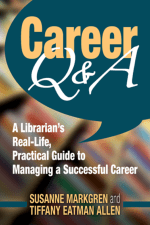
The Book is Here!

The Book is Here!

We are thrilled to announce the publication of our book, in print and ebook format. If you like our site, and like our advice, then you will like our book. We cover a variety of career topics and most chapters include sidebars from working librarians at different stages of their careers. We hope you like it, because it wouldn’t have been written without this site, and our readers.

Career-QA

Career Q&A presents the following 14 chapters:

  1. The Beginning: Getting Started or Getting Going
  2. Making a Good First Impression: The Art of the Cover Letter
  3. Documenting Your Employment History: The Art of the Resume
  4. Online Identities: Managing Your Online Presence and Building Your Brand
  5. Interviewing: Getting Ready for the Show
  6. Networking: Getting Involved in the Profession
  7. From Here to There: Time for a Change
  8. Putting Yourself Out There: Presenting and Writing
  9. Job Flexibility: Possibility or Myth?
  10. Alternative Jobs: The Nontraditional Career Path
  11. Moving Up the Ladder: Stepping Into Management
  12. Keeping Up: Following Technology and Trends
  13. Collaboration: Forming Productive Partnerships
  14. Retirement: Wrapping Up Your Career and Planning for the Next Stage

Go here or here or here for more information, to read a sample chapter, and to purchase the book.

Q: What advice can you give me about transitioning from a school library to a public library?

Q: What advice can you give me about transitioning from a school library to a public library?

Q: What advice can you give me about transitioning from a school library to a public library?  Has anyone else done this? Is it even possible?

TA: You’re in good company because this is a question we get pretty frequently—Can I transition from one type of library to another?  In my opinion, the best place to start is with a careful analysis of the skills and experiences you have and then compare those with the skills and experiences required in the new position.  Also be sure to think about user populations and work activities, and how these can be the same (and how they can be different) across different types of libraries.  The goal is to identify transferable skills and highlight those in your application materials.  It’s also helpful to mirror the vocabulary you see in the vacancy announcement or position description.  So, for example, instead of using the term “student” or “pupil” when describing your user, use the term (possibly “patron” or “customer”) used to describe the user population in the vacancy announcement for the public library.  The more connections you can draw between your experience and the desired qualifications of the new position, the easier it will be for the hiring manager or committee to see you in the position.  You should check out our other posts on transferable skills, specifically one posted in July 2010.

For others out there: Have you made the career switch from school libraries to public libraries?  What advice would you offer?

Q: I am currently a school librarian who is ready to expand her horizons…

Q: I am currently a school librarian who is ready to expand her horizons…

Q: I am currently a school librarian who is ready to expand her horizons. I have an MLIS and am also working on an Educational Technology MS. I am moving to Seattle soon and would like tips on entering the academic library scene.


TA: Making the switch from school libraries to academic libraries can be tricky.  Academic librarians don’t necessarily see a lot of commonalities between what they do and the requirements and responsibilities of being a school librarian.  Now that, of course, is a huge generalization, and it’s not intended to discourage; the real aim here is to educate.  So, knowing that it can be tricky, you need to approach this wisely.  First, having an additional master’s degree will be a real asset, especially in educational technology.  Next, moving from one library to another, especially in another geographic area, is a great second chance at a first impression.  That is, you can really reinvent yourself.  Look at professional associations in the area that focus on academic libraries and jump in.  It’s a great way to network, meet folks in the area, and establish a professional reputation for yourself in the new geographic location.  Third, I think it’s important to consider your strategy in moving from one library to another.  It might be difficult to go from a small school library to a large academic library.  But you could try something more manageable in strategically going from a small school library, to a large public library.  Then maybe from the large public library to a community college library, from community college to small academic, from small academic to large academic.  You achieve your goal but in strategic, manageable, progressive career steps.  There’s no one way that fits everyone, so don’t limit yourself when plotting out your career path.  Be sure to look at our other responses that touch on transferable skills.


And I’m curious about other folks and their experience.  Anyone successfully made the move from school to academic?  Anyone in the Seattle area want to share their experience about living and working in the region?  Any tips for new librarians getting started in Seattle?

Q: Should I contact a potential employer with questions before applying for a job?

Q: Should I contact a potential employer with questions before applying for a job?

Q: I’m just about to finish my MLIS and I am hopefully about to begin my career in librarianship. One thing I am unsure about is whether or not you should contact the person listed for informal inquiries prior to applying. Some people say it is useful as it will put you on the radar of those hiring while others discourage it. One particular position I am looking at at the moment is listed as a Trainee role and I thought it might be useful to ask about the training they will be offering (for example). Should you contact them or just apply?

SM: Congratulations on completing your degree and best of luck to you as you begin your library career!

Trainee positions (and fellowships) are designed to provide recent graduates with experience and actual hands-on training prior to getting that first professional position. The trainee role can be beneficial for someone with little or no prior library experience and it can also be an excellent entrée into librarianship for any new librarian.

These types of positions can mean different things in different libraries, so you will want to make sure that you understand all the requirements, expectations,  and terms. Trainee positions may be for library school students or for recent graduates. They can be temporary (one-year, academic year, etc.), or they can encompass the first year of a permanent position… a trial period where one learns the ropes before taking on greater responsibilities.

Overall, I think these programs are very much needed — both for the growth of our individual careers and for the health of the profession. We need to continue to develop programs for mentoring and nurturing our newest members, in order to create the next generation of dynamic and confident leaders; and we need to take the time to fully train and integrate new hires into their roles and help them to meet and exceed the demands and expectations that are put on them.

Here are my thoughts on asking questions of potential employers:

  • If there is an actual person listed, and they are defined as the person to contact for “informal inquiries” then go ahead and contact that person.
  • Since this is a trainee position, which is different from a typical position, you may want to clarify exactly what you will be doing on the job, especially if is isn’t clear in the job description.
  • Do not think that by contacting a potential employer with questions that you are putting yourself in a better position to get the job. Getting on someone’s radar is not always a good thing.
  • In the interview stage you will have a chance to get all your questions answered. This is the place to ask lots of questions, not necessarily before you apply for a position.
  • Think of ‘getting an interview‘ as an accomplishment, and ‘interviewing‘ as training. The more you interview, the better you get at it. And interviewing is the only way to know if you really want a position. Something that looks great on paper may be not-so-great in person, and vice versa.

To sum up: if you have pressing questions that you would like answered before you apply and the job listing has a contact for asking questions, then you should feel free to ask. If there is no name listed, you can attempt to contact the human resources department to get your questions answered (do not contact the library director!). As long as you maintain a professional demeanor and don’t attempt to promote yourself in your correspondence (or get noticed or rewarded in any way), then all should be well.